
For a while, using a BenchPod meant importing it out of a local checkout: fine for developing the SDK itself, useless for anyone who just wanted to write a hardware test. That changed with one small, unglamorous milestone: embeddedci landed on PyPI. pip install embeddedci, then pytest, and the hardware test suite runs like any other.
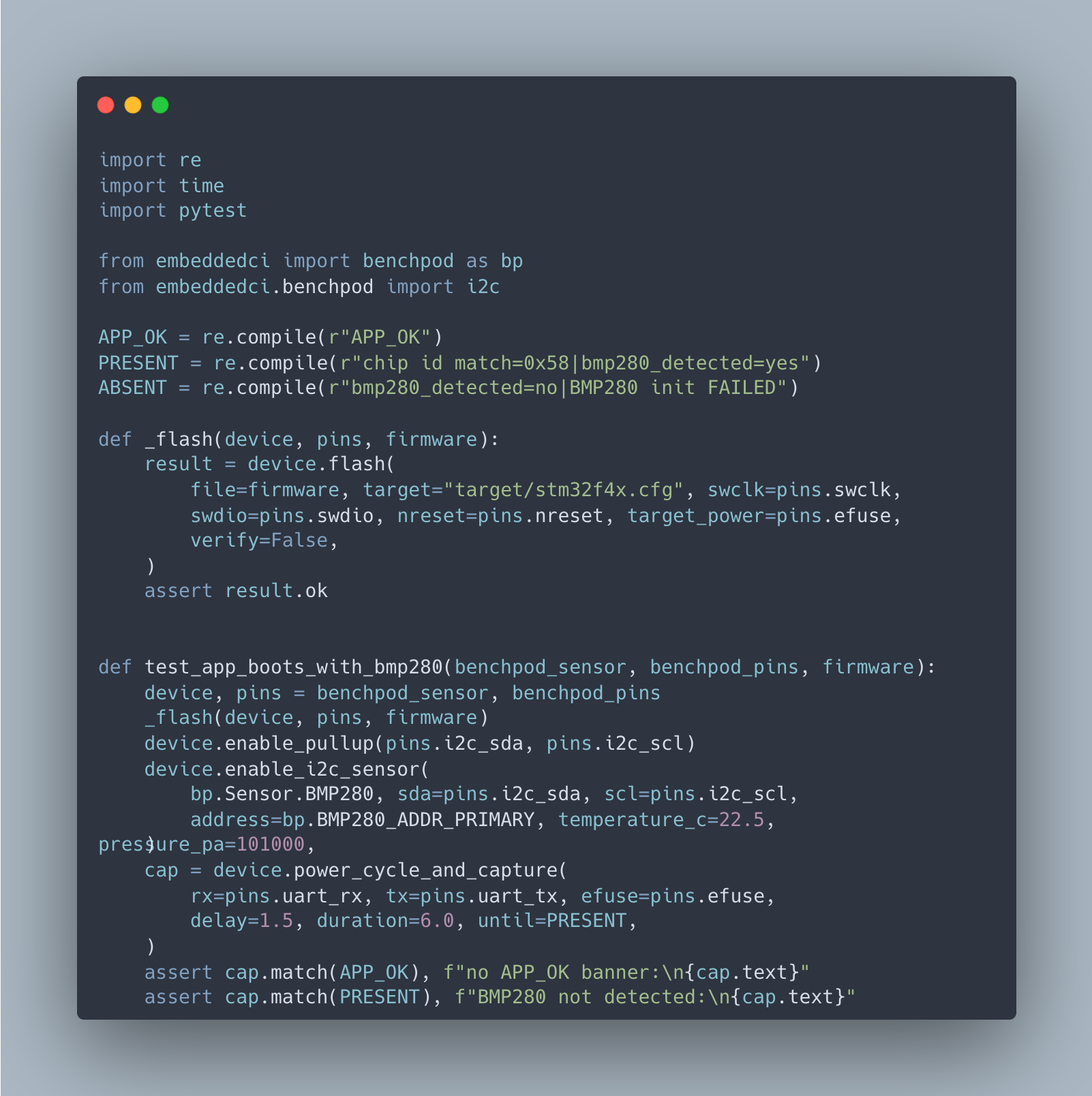
It's a small change with an outsized effect, because it's the piece that turns "a board on a bench with a debug probe" into "a fixture in a test file." The whole point of packaging it was to make this the boring, ordinary end-to-end loop:
- Attach a BenchPod to the target device.
- Point it at a network: configure Wi-Fi or Ethernet and find the device from the CLI.
pip install embeddedci.pytest.- Wire that same test into CI, either a local runner sitting next to the hardware, or embeddedci.com proxying the request to a pod anywhere else.
Steps 1 and 2 are a one-time bench setup. Steps 3 through 5 are what most projects actually repeat, and packaging the SDK is what makes step 3 a single, ordinary pip install instead of a checkout of someone's firmware repo.
Why this was worth doing before the hardware was "done"
At the point this shipped, the board itself was still mid-generation: the switch from the v1 RP2350B design to the STM32H563-based v2 hadn't happened yet. Packaging the Python side first, ahead of the hardware settling, was deliberate: the SDK and the pytest integration are the surface every test author actually touches, and they're the part that most needed to stop feeling like a research prototype. A board revision changes wiring and part numbers; it shouldn't change how someone writes def test_boots(benchpod): ....
That decoupling is also what let later work, the GitHub Actions cloud path and the on-pod CMSIS-DAP probe, bolt onto the same benchpod fixture without changing the shape of a test. If you want the fast path from a fresh pip install to a green hardware test, that's Your First HIL Test in 15 Minutes; the fixture and CLI reference lives in the pytest framework docs.